
Drones
Drones
Drones, also known as Unmanned Aerial Vehicles
(UAVs), are advanced aerial systems designed to
perform a wide range of tasks without direct human
control onboard. .
In the defense and law enforcement sector, drones
are used for reconnaissance, border patrol, search
and rescue, and real-time situational awareness.
Government organizations employ drones for
disaster management, infrastructure inspection, and
environmental monitoring.
In commercial and industrial sectors, drones assist
in surveying, agriculture, logistics, and asset
management.
With their ability to access difficult terrains, provide
live imagery, and operate cost-effectively, drones
have become essential tools for modern security,
intelligence, and operational efficiency.
General Features
- Modular and Compact Design
- Foldable Frame
- Long Endurance
- Backpackable
- Environmentally Robust
- Standalone artillery fire correction capabilities
- Integrable with AFCS for Fire Correction
- Customizable as per user requirement
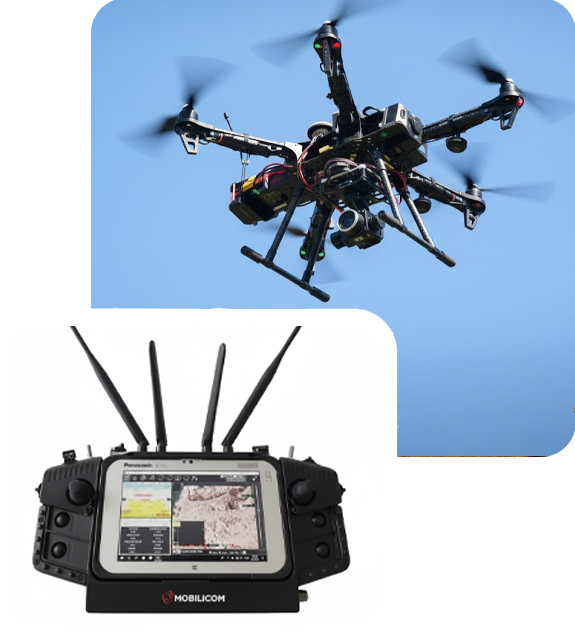
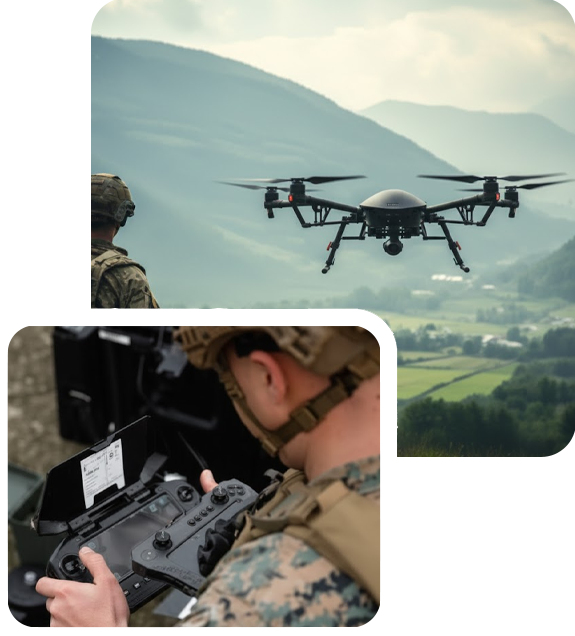
Counter IED Drone
Counter-IED (Improvised Explosive Device) drones are
specialized unmanned aerial systems designed to detect,
surveil, and support the safe mitigation of explosive
threats from a standoff position. These platforms
combine stabilized electro-optical/infrared (EO/IR)
cameras, ground-penetrating or synthetic aperture radar
(where permitted), chemical/vapor sensors, and secure
datalinks to locate suspect objects and provide real-time
situational awareness to Explosive Ordnance Disposal
(EOD) teams.
General Features
- An Advanced Multi-Rotor UAS for IED Disruption
- Precise targeting at a 25-meters standoff distance.
- Modular and Rugged Design
- Digital Aiming
- Large Payload Carrying Capacity
- User Customizable
Assault Drone
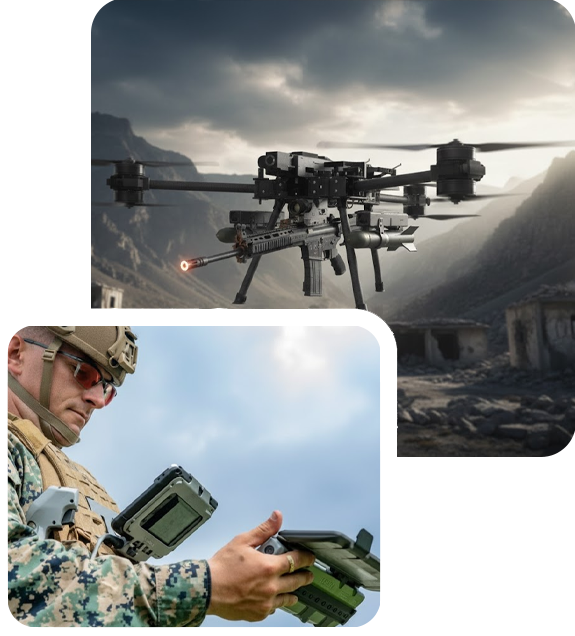
Modern warfare increasingly integrates advanced technology to enhance soldier safety and effectiveness.
The Assault drone is a cutting-edge UAV that combines AI precision with the firepower of the assault rifle. It features
auto-tracking capabilities, allowing it to autonomously identify, track, and engage targets, significantly improving
frontline support. Designed for various combat scenarios.
The Assault drone can also drop mortars and provide reconnaissance, making it a versatile tool for rapid and accurate responses to threats on the battlefield. .
General Features
- Precise targeting through Detection, Recognition and Identification (DRI)
- Automated Stabilization for target aiming and remote firing
- Active/ Dynamic Recoil Compensation
- Thermal, Optical & IR Imaging via front-mounted camera and scope
- Adaptable to both manual and autonomous flights.
- Mortar-dropping mechanism for versatile operation needs
- Customizable Payload as per user requirements.
Logistic Drone
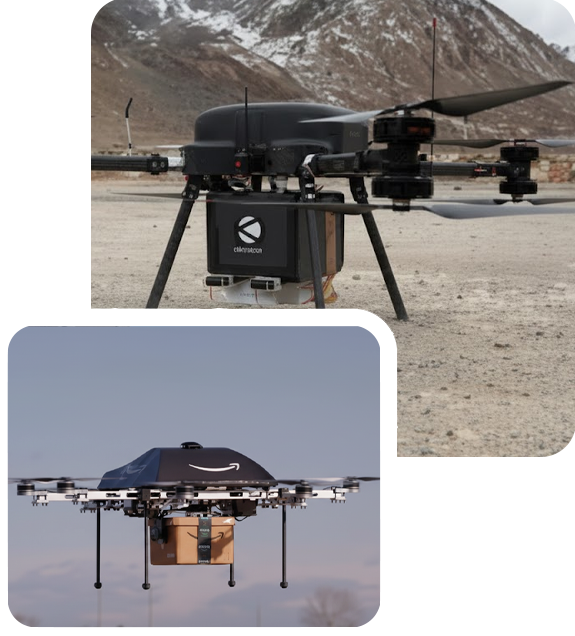
Logistic drones are unmanned aerial systems designed to carry cargo from small parcels to critical supplies reliably and efficiently across short to medium distances. They come in VTOL multi-rotor designs for point-to-point delivery in urban or confined areas, fixed-wing types for longer-range bulk deliveries, and hybrid platforms that trade off endurance and vertical lift. Logistic drones are built around safe cargo bays, GPS/INS navigation, and mission management software that integrates with warehouses and fleet
systems
Key uses & examples
Medical & emergency supply delivery: Rapid transport of blood, vaccines,AEDs, and medicines to remote clinics or disaster zones.
Police & public safety support: Fast delivery of first-aid kits, evidence bags, or specialized sensors to incident sites without tying up manned vehicles.
Critical infrastructure & maintenance: Transport of tools, spare parts, or sensors to towers, pipelines, or offshore platforms.
Last-mile commercial delivery: E-commerce parcels and documents in congested urban areas where road delays are costly.
Humanitarian aid: Food, water, and small relief packages to communities cut off by flooding or conflict.
General Features
- Rugged and Modular Design
- Large Payload Carrying Capability
- Customizable as per user requirement
- Environmentally Robust
- Rapid Deployment
- Integration Capabilities
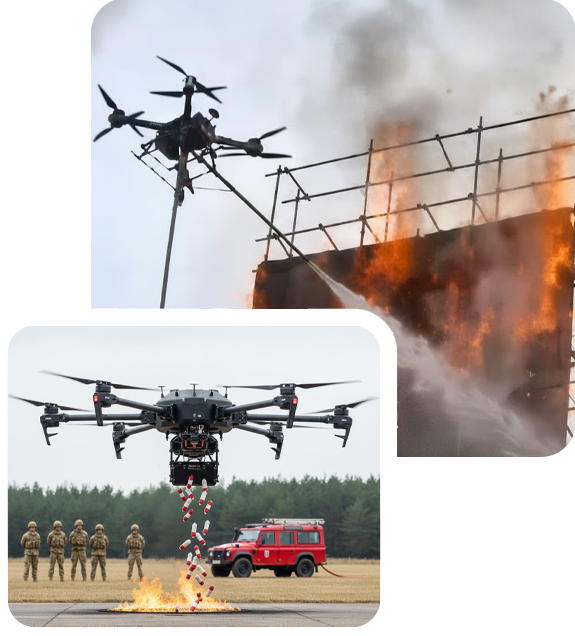
Firefighting drones
Firefighting drones are unmanned aerial systems purpose-built to support firefighting and emergency-response teams by providing rapid aerial situational awareness, sensor data, and limited delivery capabilities all while keeping personnel out of harm’s way. They act as force multipliers during wildfires, urban fires, industrial incidents, and search-and-rescue operations.
Primary roles & examples
Aerial reconnaissance & situational awareness:Live high resolution EO/IR video and thermal mapping to locate hot spots, fire fronts, and trapped victims.
Incident command support:Real
-time feeds and georeferenced overlays
for commanders to plan containment lines, allocate resources, and track assets.
Hot-spot detection & mapping: Thermal sensors create heat maps to find smoldering areas that are invisible from the ground.
Search & rescue: Rapid search of wreckage, dense smoke, or rough terrain to locate people and direct ground teams.
Light payload delivery: Transport of small firefighting tools, survival kits,or chemical markers to guide crews (not for dropping fire-extinguishing loads unless certified).
General Features
- Advanced Thermal imaging technology for detecting hotspots and fire sources
- High-resolution cameras for real-time monitoring and fire conditions
- Precision water or foam spraying system for effective firefighting
- Ability to communicate with ground firefighting teams for coordinated efforts
- Customizable as per user requirement
Agriculture drones
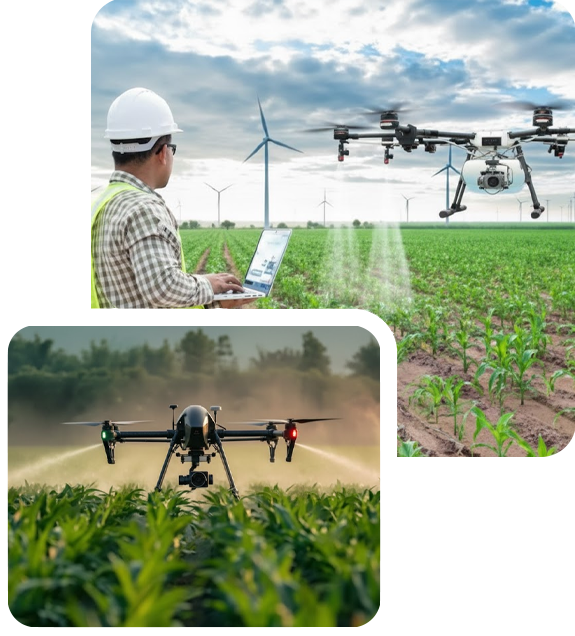
Agriculture drones,also known as Agri-UAVs, are transforming modern farming by enabling precision agriculture and efficient resource management. Equipped with high-resolution cameras, multispectral and thermal sensors, and GPS-based navigation systems, these drones help farmers monitor crop health, assess soil conditions, and optimize irrigation and fertilizer usage.
They can conduct aerial mapping, crop scouting, and plant stress analysis, allowing early detection of pests,diseases, and nutrient deficiencies. In addition to monitoring, certain agriculture drones are capable of seed broadcasting and spraying fertilizers or pesticides with high accuracy, reducing chemical waste and labor costs. By providing real-time data and analytics, agriculture drones empower farmers, agronomists, and large-scale agricultural organizations to make informed decisions,improve yields, and promote sustainable farming practices.
General Features
- Spraying and Seeding System
- Autonomous Flight Planning
- Real-Time Data Transmission
- Seamless Remote Operation
- Foldable and Portable Design
- Customizable as per user requirementomizable